Introduction
In everyday life, agreements are made casually, but not all of them carry legal weight. Under Section 10 of the Indian Contract Act, 1872, only those agreements that fulfill specific essential conditions become valid and enforceable contracts.
- Concept of Provision
This is the section that forms the basis of enforceability of all contracts. As we know
Contract= Agreement+ Enforceability by law
This section tells us the conditions for an agreement to become enforceable by law, thus becoming a contract.
- Intention
This Section distinguishes daily agreements from legally binding contracts. It prevents the exploitation of people by ensuring that free consent and capability to contract are part of the conditions. It guarantees that contracts are not based on illegal, immoral, or socially detrimental activities. The section ensures that the parties intended to create a legal relationship and provides legal remedies in case of breach of contract.
Conditions
“What agreements are contracts.—All agreements are contracts if they are made by the free consent of parties competent to contract, for a lawful consideration and with a lawful object, and are not hereby expressly declared to be void. Nothing herein contained shall affect any law in force in 1 [India] and not hereby expressly repealed by which any contract is required to be made in writing, or in the presence of witnesses, or any law relating to the registration of documents.”
Analysis
- The conditions as stated by the Section are:
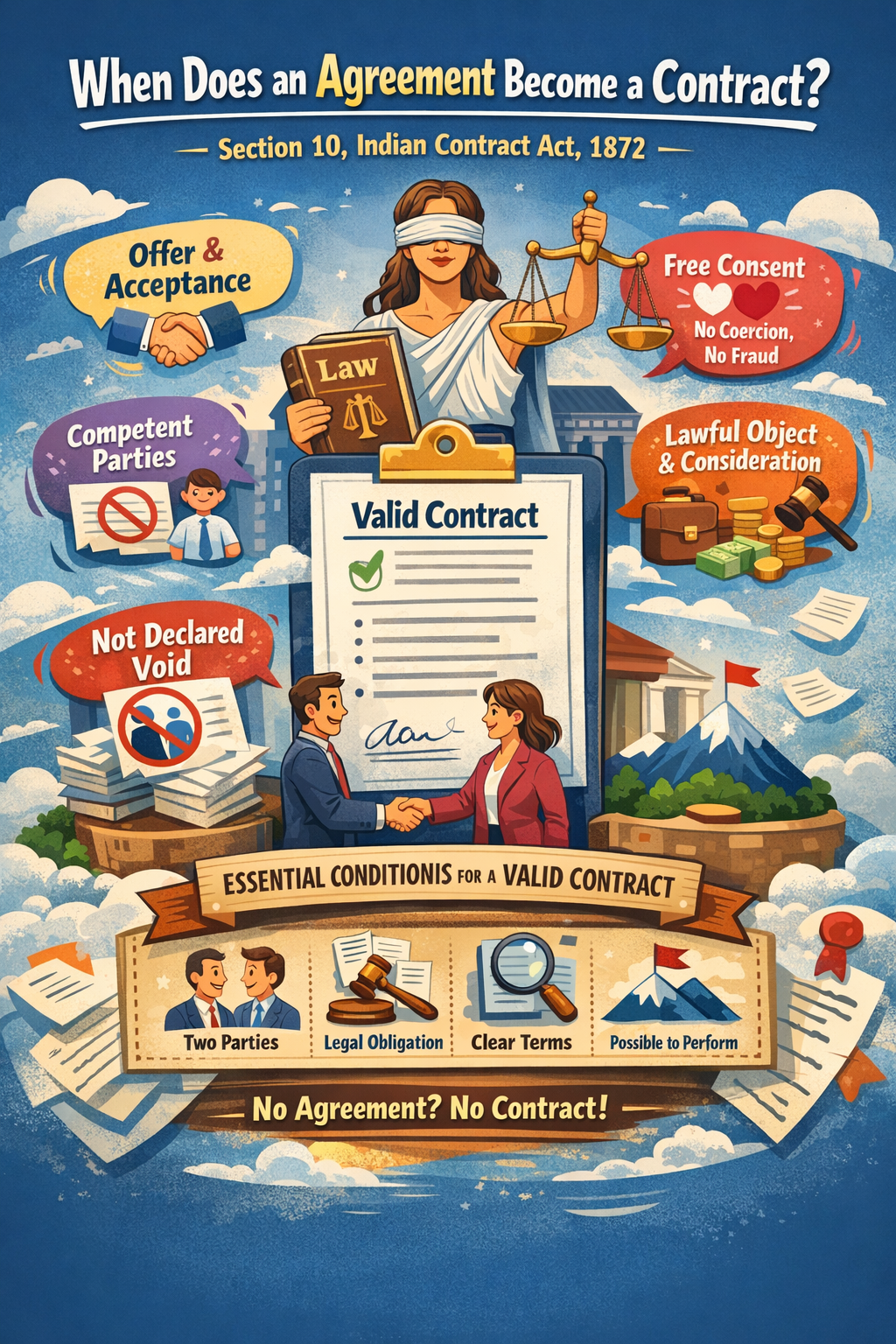
- Agreement(Section 2(e)) : An agreement is formed when an offer extended to and is accepted by the offeree.
- Free Consent(Section 14) : The agreement must be formed by parties whose consent is not influenced by factors like coercion, fraud, undue influence, and so on. These factors are further detailed in Sections 15,16,17,18, 20, 21, and 22.
- Competent Parties( Section 11) : The parties to a contract must be competent by law to uphold the contract, i.e., they must be of majority, must not be of unsound mind , and so on.
- Lawful object and consideration : The purpose and the consideration ( something in return) of the contract must be allowed by the law, not fraudulent and not opposed to public policy.
- Not Void: The agreement must not be a type which is specifically declared as void by the law.
- The Section further indicates that
- These conditions must all be fulfilled in order for an agreement to become a contract.
- This Section does not override any law in force in India.
- This Section does not override any law that makes it compulsory for witness presence, contract in writing or registration of documents.
(c ) The conditions subtly implied by the Section, but no less essential are:
- Two Parties: A person cannot contract with himself. The contract may be between natural persons as well as artificial persons like companies or partnership firms.
- Legal Obligation: There must be an intention to create legal obligation. Social and domestic agreements are not enforceable by law.
- Legal Formalities: As stated above, this Section implies that it does not override any law that makes it compulsory for any legal formality like witness presence to create a specific type of contract, e.g., a contract of insurance has various legal formalities that must be followed.
- Meaning: The contracts whose meanings are ambiguous, vague or indefinite are not enforceable.
- Possibility: As per Section 56 of the Indian Contract Act,1872, a contract to perform an impossible act is void.
Conclusion
Section 10 of the Indian Contract Act, 1872 ensures that only agreements meeting essential legal conditions become enforceable contracts. It highlights the importance of consent, competency, lawful consideration, and lawful object in determining validity. Together, these elements ensure that contractual relationships are fair, reliable, and legally binding.
Disclaimer: This article is for academic and informational purposes only. It’s not legal advice or a substitute for professional judgment. Readers should verify provisions, check updates, and seek specific advice. No liability for errors or reliance.
Vedashree A.
CA Aspirant